Transformation without truth is just high-priced theater
The evidence is clear
95%
95% of AI pilots fail when human factors are ignored (MIT 2025)
40%
40% faster time-to-hire for adaptable organizations (McKinsey)
3-5x
3-5x productivity gains where humans and AI truly partner (Multiple sources)
4.5M
$4.2M average cost of ignoring shadow AI risks (Industry average)
We measure the gaps that kill transformations. Then close them.
How we drive business outcomes
Every failed AI transformation has the same root cause: The gap between leadership assumptions and organizational reality.
While others impose top-down solutions, we surface bottom-up innovations. While others measure sentiment, we measure capability. While others promise change, we embed it.
The difference: We bet on your people, not what worked at Google.
Your AI Transformation Has a Blind Spot. We'll Show You Where.
Every failed AI transformation has the same root cause: The gap between leadership assumptions and organizational reality.

Reality Gap Assessment™
Uncover the disconnects between leadership intent and organizational execution (so you stop investing in initiatives that won't scale).
The Truth About Your AI Readiness
Parallel 45-minute interviews with C-suite and employees reveal:
- The Strategy-Reality Delta - Where leadership confidence meets ground truth
- Shadow AI Economy - 67% of innovation happens without your knowledge
- ROI Validation - Which AI investments will actually deliver vs. expensive experiments
- Initiative Alignment - Why pilots succeed in isolation but fail at scale
- Competitive Blind Spots - Where rivals are already 3-6 months ahead
Output: Actual proof of gaps that determines your entire transformation strategy

Adaptability Index™
Measure actual workforce readiness and capability — not self-reported comfort — so you know who will drive your transformation.
The organizations that measure and manage human adaptability win. Period.
15-minute AI-led conversation to measure what people can do, not what they say they can do:
- Learning Velocity - Speed from "I don't know" to "I can use this"
- Cognitive Flexibility - Ability to abandon old ways for new possibilities
- Technological Fluency - Actual AI effectiveness, not just usage
- Resilience & Recovery - Bouncing forward when AI fails
- Collaborative Agility - Human + AI synergy in fluid teams
Key difference: We ask "tell me about the last time you..." not "rate yourself 1-5"
Output:
- Individual capability scores (0-100)
- Talent segmentation: Champions (15%) → Rising Stars (30%) → Developing (40%) → At Risk (15%)
- Quarterly tracking proves whether transformation is actually working
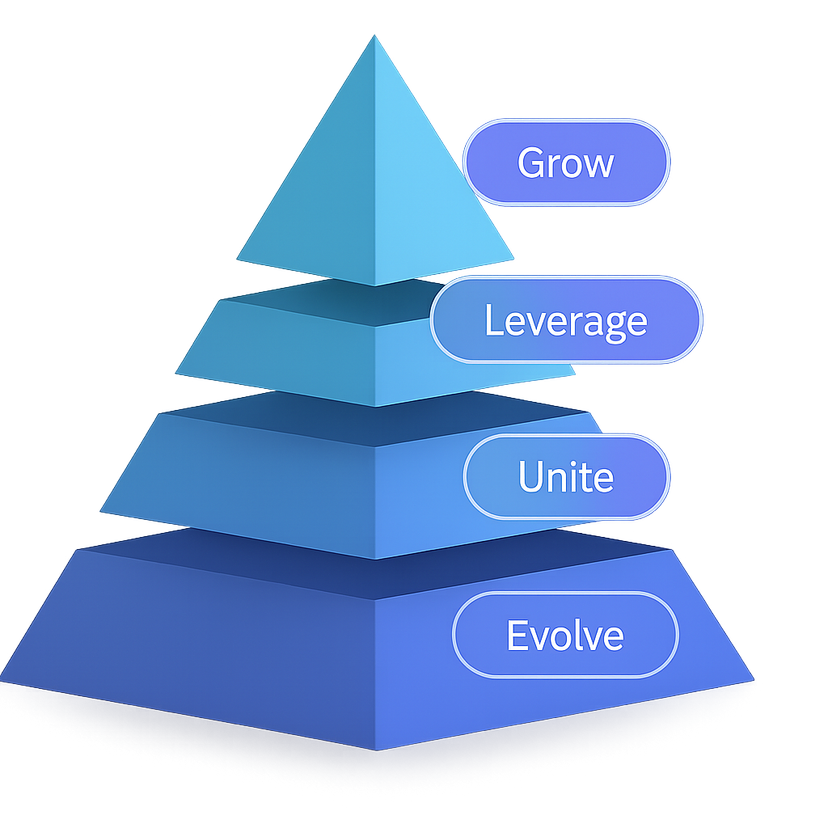
GLUE Transformation System™
A staged execution model that turns gaps into capability and delivers ongoing change, not just a "done for now" report.
From Diagnosis to Market Domination
- GROW (Weeks 1-4) Build foundation through targeted bootcamps and safe experimentation
- LEVERAGE (Weeks 5-8) Create breakthrough moments where AI multiplies human capability 3-5x
- UNITE (Weeks 9-12) Activate networks that spread transformation organically
- EVOLVE (Weeks 13-16+) Embed continuous evolution that keeps you ahead
From Gaps to Transformation
Every gap demands a different intervention. Here's how we close them:
When Strategy Meets Reality
Gap: 73% of employees can't connect AI initiatives to their work Fix: Executive alignment workshops + Shadow AI scaling sessions Result: Strategy becomes capability, not PowerPoints
When Leaders Aren't Leading
Gap: C-suite talks AI but can't demonstrate it Fix: AI amplification bootcamps + Decision velocity training Result: Leaders who drive transformation, not resist it
When People Can't Keep Pace
Gap: Top 10% thriving, bottom 50% drowning Fix: Role-specific mastery programs + Peer champion networks Result: Every employee becomes a competitive advantage
When Culture Kills Innovation
Gap: Fear beats curiosity, resistance beats experimentation Fix: Psychological safety interventions + Behavior embedding Result: Culture that accelerates change instead of killing it
The hmn Difference
23 weekly touch-points ensure change sticks after consultants leave.
The 3 Reality Gaps We Always Find
Gap #1: The Strategy Delusion
Leaders think AI vision is clear. Reality: 73% of employees can't connect AI initiatives to their role and only 25% of leaders see meaningful return on their AI investments
Gap #2: The Shadow AI Economy
Leaders see IT efficiency. Reality: Shadow AI costs $4.2M per breach and wastes 30-40% of IT spending —at the same time, Shadow AI use represents 60% of your actual AI innovation, but it remains invisible to leadership.
Gap #3: The Adaptability Chasm
Leaders think everyone's learning equally. Reality: Only 6% of employees feel very comfortable using AI and the top 10% of talent is getting recruited away.
We Close These Gaps Through:
- •
Evidence over opinions - Behavioral interviews reveal what people actually do, not what they say
- •
Capability building over checkbox training - 23 weekly touchpoints embed real behavior change
- •
Bottom-up innovation over top-down mandates - Scale the 67% of innovation already happening in shadows
- •
Measured transformation over magical thinking - Adaptability scores prove progress or we pivot
What Industry Leaders Know
McKinsey Global Institute (2025):
“Organizations combining AI with structured human oversight achieve 73% better outcomes. It's not about the technology—it's about adaptability.”
Boston Consulting Group AI Radar (2025):
“75% of executives rank AI as top priority, but only 25% report meaningful value. The gap? Human readiness.”
Deloitte Future of Work (2025):
“Companies prioritizing skills over degrees see 30% higher productivity in first 6 months. Adaptability beats credentials.”
Forrester AI Predictions (2024):
“60% of employees will use shadow AI tools. Organizations that surface and scale these innovations will dominate.”
Conclusion: The future belongs to the adaptable.