A practical guide for work with AI

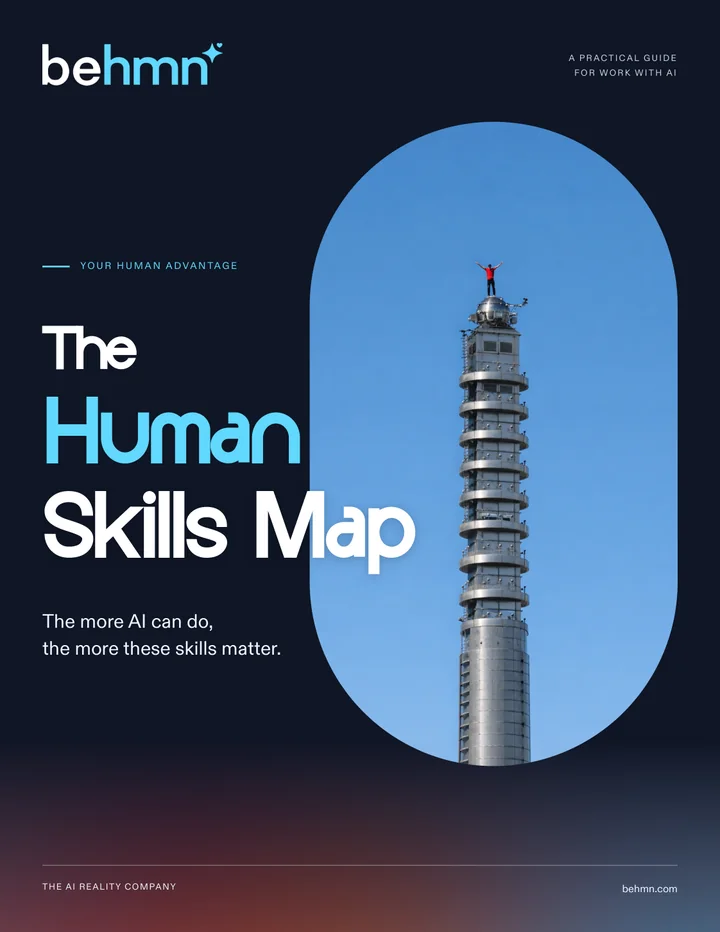
The Human Skills Map

The more AI can do, the more these skills matter.

Ten human skills that shape the questions you ask, the decisions you make, how you work with others, and what you get done.

Get the Human Skills Map

PDF · 5 pages · 3.5 MB

Explore your strengths

01 See your strengths

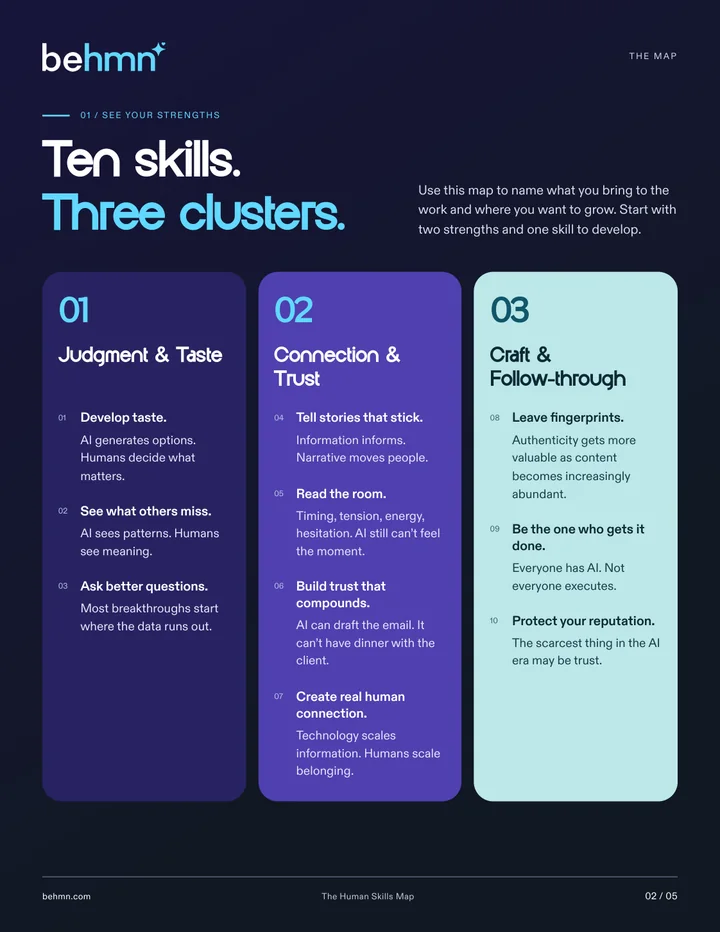
Ten skills. Three clusters.

Use this map to name what you bring to the work and where you want to grow. Start with two strengths and one skill to develop.

Judgment & Taste

  • Develop taste.

    AI generates options. Humans decide what matters.

  • See what others miss.

    AI sees patterns. Humans see meaning.

  • Ask better questions.

    Most breakthroughs start where the data runs out.

Connection & Trust

  • Tell stories that stick.

    Information informs. Narrative moves people.

  • Read the room.

    Timing, tension, energy, hesitation. AI still can’t feel the moment.

  • Build trust that compounds.

    AI can draft the email. It can’t have dinner with the client.

  • Create real human connection.

    Technology scales information. Humans scale belonging.

Craft & Follow-through

  • Leave fingerprints.

    Authenticity gets more valuable as content becomes increasingly abundant.

  • Be the one who gets it done.

    Everyone has AI. Not everyone executes.

  • Protect your reputation.

    The scarcest thing in the AI era may be trust.

Go to your action card

02 Start this week

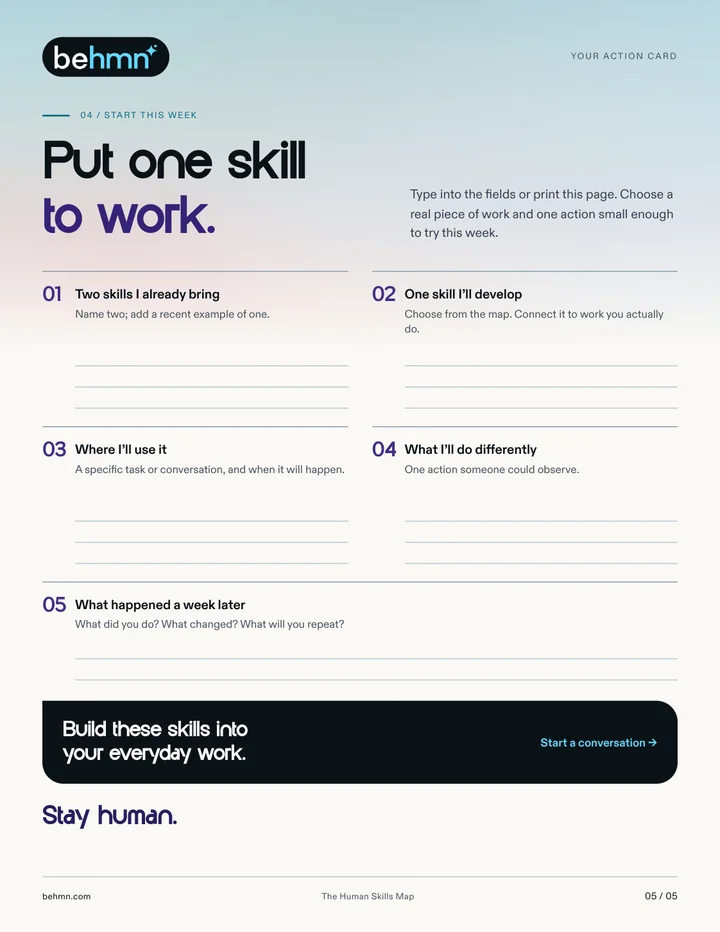
Put one skill to work.

Choose a real piece of work. Decide what you’ll do differently this week.

Type into the card or print this page. Come back in a week to reflect.

Need a starting point? See three examples

Name two; add a recent example of one.

Choose from the map. Connect it to work you actually do.

A specific task or conversation, and when it will happen.

One action someone could observe.

What did you do? What changed? What will you repeat?

In practice

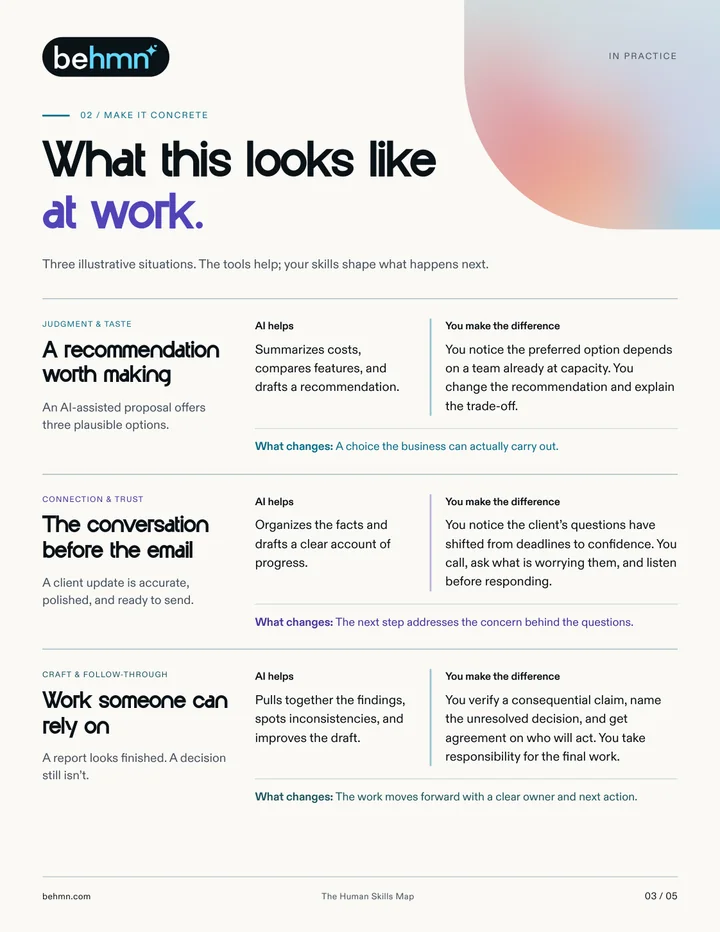
Where you make the difference.

Three illustrative situations. The tools help; your skills shape what happens next.

Return to your action card

Judgment & Taste

A recommendation worth making

An AI-assisted proposal offers three plausible options.

AI helps

Summarizes costs, compares features, and drafts a recommendation.

You make the difference

You notice the preferred option depends on a team already at capacity. You change the recommendation and explain the trade-off.

What changes: A choice the business can actually carry out.
Connection & Trust

The conversation before the email

A client update is accurate, polished, and ready to send.

AI helps

Organizes the facts and drafts a clear account of progress.

You make the difference

You notice the client’s questions have shifted from deadlines to confidence. You call, ask what is worrying them, and listen before responding.

What changes: The next step addresses the concern behind the questions.

Craft & Follow-through

Work someone can rely on

A report looks finished. A decision still isn’t.

AI helps

Pulls together the findings, spots inconsistencies, and improves the draft.

You make the difference

You verify a consequential claim, name the unresolved decision, and get agreement on who will act. You take responsibility for the final work.

What changes: The work moves forward with a clear owner and next action.

Return to your action card

For leaders

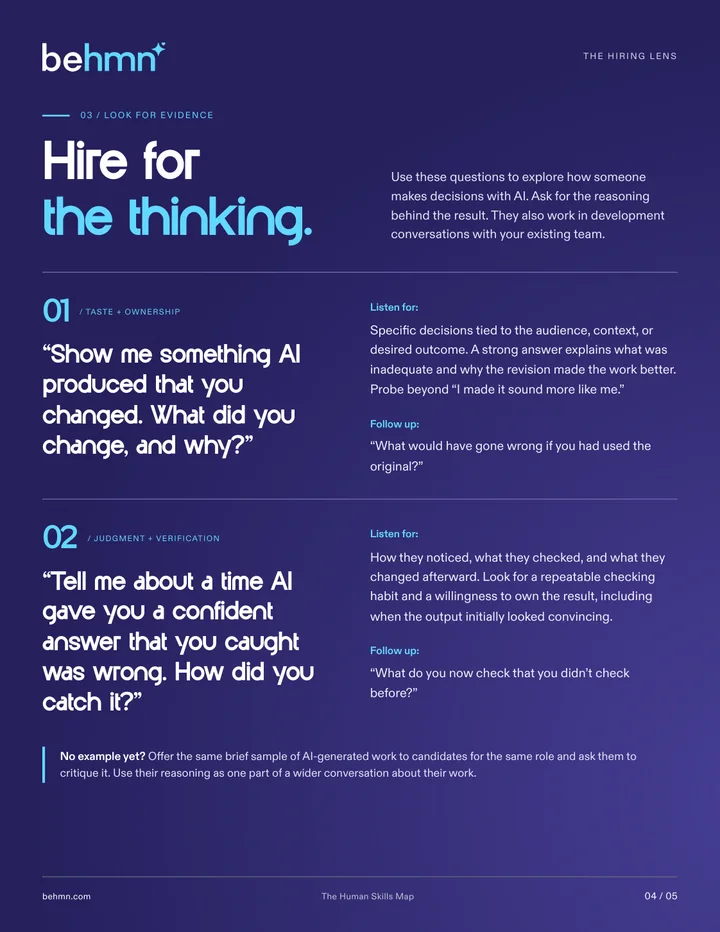
Hire for the thinking.

Use these questions to explore how someone makes decisions with AI. Ask for the reasoning behind the result. They also work in development conversations with your existing team.

01 Taste + ownership

“Show me something AI produced that you changed. What did you change, and why?”

Listen for:

Specific decisions tied to the audience, context, or desired outcome. A strong answer explains what was inadequate and why the revision made the work better. Probe beyond “I made it sound more like me.”

Follow up:

02 Judgment + verification

“Tell me about a time AI gave you a confident answer that you caught was wrong. How did you catch it?”

Listen for:

How they noticed, what they checked, and what they changed afterward. Look for a repeatable checking habit and a willingness to own the result, including when the output initially looked convincing.

Follow up:

No example yet? Offer the same brief sample of AI-generated work to candidates for the same role and ask them to critique it. Use their reasoning as one part of a wider conversation about their work.

Build these skills into your everyday work.

Start a conversation

Before, value scaled with effort. Now, it compounds.

Before: Human Skill × Effort = Value

Now: (Human Judgment × AI Capability)to the power of Collaboration = Exponential Value

The multiplier was always effort. The new multiplier is how well you collaborate with the machine. That’s a learnable skill, and it’s what we teach.

A Harvard-led field experiment with 758 BCG consultants found AI on tasks inside its competence produced 40% higher-quality work. The gains went to the people who stayed in the loop.

Harvard Business School × BCG, 758 consultants, 2023 (opens in a new tab)

AI can do more. So can you.

Get the Human Skills Map

PDF · 5 pages · 3.5 MB